AI ad research · Guide
Best Platforms for Researching ChatGPT Ads: How to Choose in a Market Less Than a Year Old
The Short Answer
The best platforms for researching ChatGPT ads depend less on brand names than on the depth of research you need. Independent ad-observation tools work from samples, and a large library is not a full census of paid activity. For a quick check — "is anyone in my category already buying?" — a public library such as the LLM Pulse ChatGPT Ads Library is a useful starting point. For ongoing competitive monitoring, a paid intelligence suite like Adthena’s ChatGPT Ads Intelligence adds tracked prompts, share of voice, and exportable ad libraries. For lightweight, occasional checks, a browser extension or a disciplined do-it-yourself sampling routine works. For brand mentions in AI answers, AI-visibility tools provide a different evidence layer. Check the specific module: an organic visibility score does not establish paid ad activity. This article gives you a framework to match platform archetypes to your research depth, five criteria to score any candidate, and an honest account of what this data can and cannot prove.
Why "Best" Is a Moving Target in a Market Less Than a Year Old
OpenAI began testing ads in ChatGPT in February 2026. Its European expansion announcement added 31 markets that August. Criteo announced its integration with the advertising pilot on March 2, 2026, describing itself as OpenAI’s first advertising technology partner.
The product landscape is still young, and today’s shortlist should be treated as a dated assessment. Independent libraries differ in the prompts, countries, accounts, and collection periods they observe. Do not mistake a vendor’s catalog for an official OpenAI archive or assume that two vendors have the same coverage.
Regulation may also change the available evidence. The European Commission designated ChatGPT a Very Large Online Search Engine on August 31, 2026, with additional DSA obligations due by January 2027. That announcement is not a release notice for a working ad-search product. Re-evaluate the market when an official repository is actually available and its coverage can be checked.
The Four Platform Archetypes
Four archetypes provide a useful way to compare products; a vendor may offer more than one. The distinction matters because the archetypes answer different questions, and comparing a product from one archetype against another usually produces a misleading verdict.
| Archetype | What it captures | Cost today | Best for | Main limitation |
|---|---|---|---|---|
| Public ChatGPT ad library (e.g., LLM Pulse's ChatGPT Ads Library) | Observed sponsored placements with advertiser, message, country, and observation dates | Public sample; sign-in enables limited search; broader access may require a plan | A quick category check and market-entry timing | Sample, not census; the global library has no export |
| Paid competitive intelligence suite (e.g., Adthena ChatGPT Ads Intelligence, flat $399/month with a 21-day trial) | Tracked prompt sets, ad presence rate, share of voice, prompt-gap discovery, searchable and exportable competitor ad library, AI analyst | Subscription | Tier-3 competitive programs with reporting duties | Coverage limited to tracked categories; premium price |
| Browser extensions and DIY sampling | Whatever you trigger yourself: screenshots of placements on your own or research accounts | Free to near-free | Lightweight spot checks and learning the ad format | Manual history and limited scale; easily biased by your own account profile |
| AI-visibility platforms (e.g., Profound, Peec AI, Otterly.AI) | Organic brand mentions, citations, sentiment, and visibility across AI answers | Subscription; verify the current plan and module | GEO and AI-search visibility programs | A visibility metric alone does not identify sponsored placements; verify any paid-ad module separately |
The fourth row is a common source of confusion. Profound, Peec AI, and Otterly.AI offer AI-search visibility workflows, but a brand mention, a citation, and a sponsored placement are different records. A vendor may add paid-ad tools alongside organic tracking. Ask to see the specific record and its source instead of inferring ad coverage from the company’s general positioning.
LLM Pulse’s library documentation distinguishes anonymous samples, limited signed-in results, and wider paid browsing. It also distinguishes the global library from project-level ad reports. “Free library” should not be read as unrestricted access to all records or exports.
Match the Platform to Your Research Depth
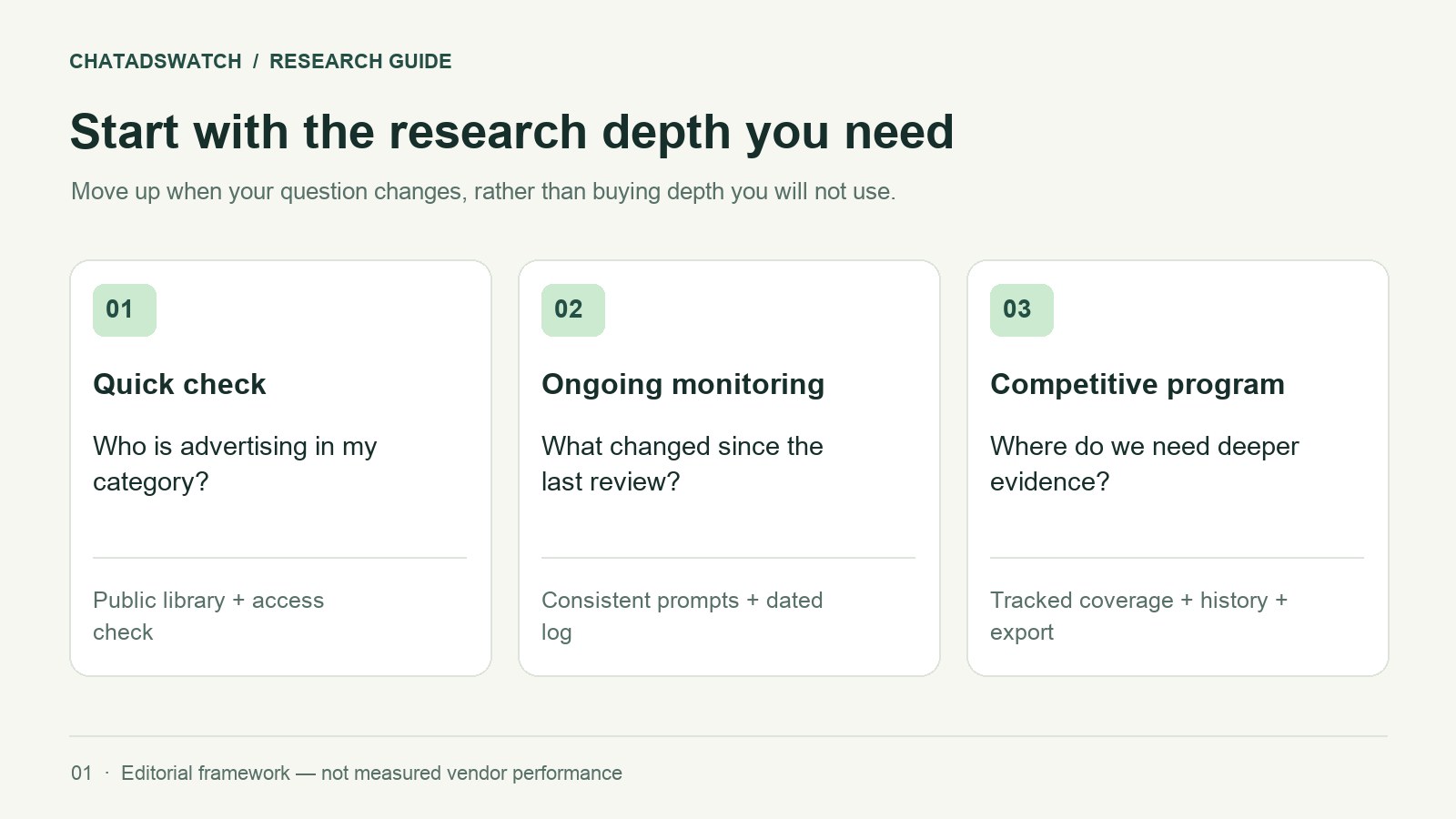
Rather than asking "which platform is best?", ask "how deep does my research go?" Three tiers cover nearly every situation.
Tier 1 — Quick Check. You want to know whether anyone in your category is already advertising and what their message says. Start with a public sample, then use any available signed-in search and country filters to inspect your category. Check whether the complete creative requires an account or paid access. This is the tier most marketers should start on, because it costs nothing and tells you whether the channel deserves a line in your 2026 plan at all.
Tier 2 — Ongoing Monitoring. You have decided the channel matters and want a weekly read on competitors: new entrants, creative changes, which prompts carry ads. Here you combine the free library with a lightweight tracking routine — a fixed prompt list you re-run on a schedule, logged consistently. A browser extension can support this, but the discipline of the log matters more than the tool.
Tier 3 — Full Competitive Program. You are advertising (or about to) and need share-of-voice tracking, prompt-gap discovery, ad-copy benchmarking, and exports your team can put in front of leadership. This is where paid suites justify their price: Adthena, for example, says its category-based dashboard is populated within 72 hours. Treat that as a vendor service claim, and test whether your actual prompt set and reporting needs are covered during the trial.
Moving up a tier before you need it wastes money; staying down a tier after your questions change wastes weeks. Re-assess your tier whenever your team's questions shift from "what is running?" to "what should we run?"
What Platforms Actually Capture — and Why Samples Differ
Ad-specific tools record observed sponsored placements and attach metadata. Their collection methods can differ, so ask whether observations come from a vendor-run prompt panel, an upstream source, or user-contributed captures. Then ask which countries, accounts, dates, and prompt types that method covers.
First, repeated sampling matters. Ads can vary across otherwise similar sessions, so one run cannot establish the full set of advertisers. There is no verified universal number of repetitions that guarantees complete coverage. A hypothetical panel of 200 prompts and one of 20,000 prompts can produce different libraries; those figures illustrate panel size, not a measurement of any vendor.
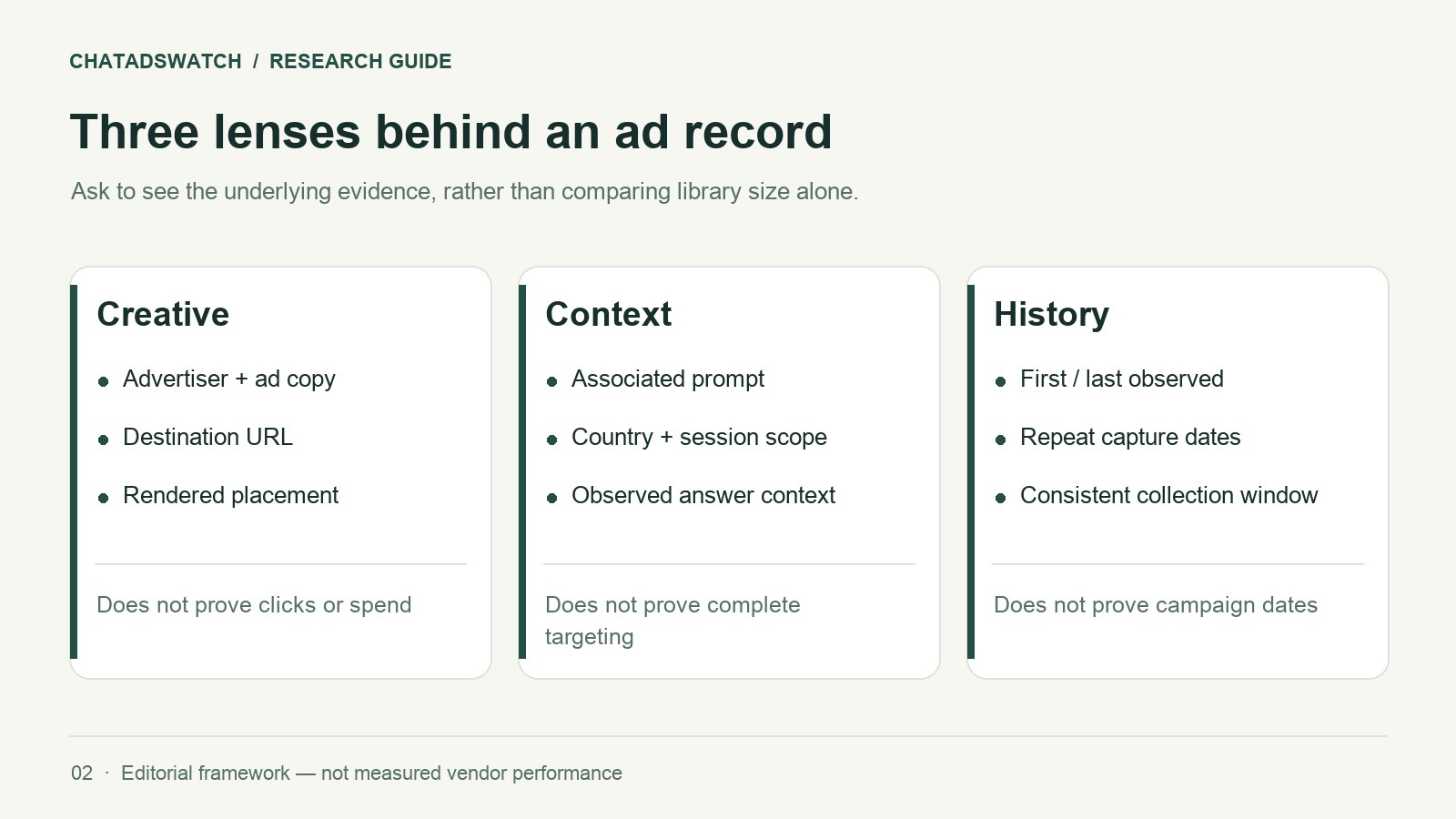
Second, the three lenses in Figure 2 — creative capture, prompt and context data, and longitudinal history — are held to different depths by different products. A library may show the creative and country while withholding the underlying prompt. A monitoring suite may preserve comparable observations over time. A screenshot becomes useful history only if you save it with consistent dates and context. When two platforms disagree, inspect their collection scope and evidence before deciding either is wrong.
Five Criteria to Score Any Platform
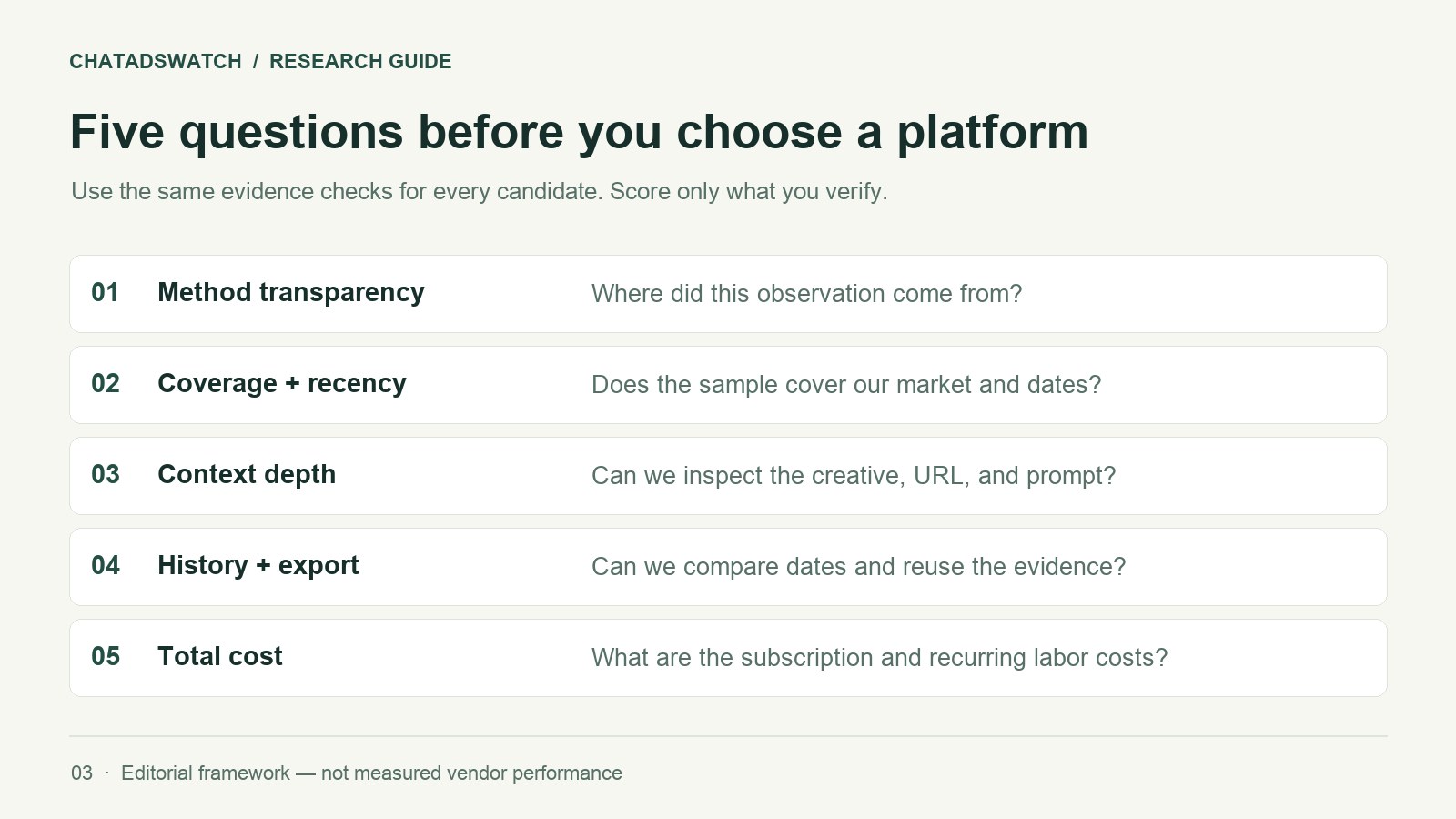
Before comparing prices, score each candidate on five criteria. Figure 3 turns these criteria into questions for a trial. It contains no measured vendor scores; score your actual shortlist only after checking evidence.
- Method transparency. Does the vendor plainly state that its data is observed, traceable to its collection method, and a sample rather than a census? LLM Pulse’s library documentation, for example, describes the observed sample and its access limits. A vendor that obscures its method is a vendor whose numbers you cannot defend in a meeting.
- Coverage and recency. How many countries and prompts does it observe, how often does it refresh, and does coverage extend to the markets you actually sell in? A library strong in the US is of limited use the week your target country opens.
- Context depth. Does a record include the creative, the destination URL, and the surrounding answer or at least the prompt category? Conversational intent helps explain an observed placement, but an associated prompt does not reveal the advertiser’s complete targeting settings.
- History and export. Can you see when a placement first and last appeared, and can you get data out for your own reporting? Free tiers often restrict export; confirm before you build a workflow on it.
- Total cost, including your time. A free library plus four hours a month of manual work can cost more than a $399/month suite. Price the labor, not just the invoice.
What Platform Data Can and Cannot Prove
This category runs on observed data, and observed data has hard boundaries that no subscription removes.
An observed placement proves the ad appeared, nothing more. It does not confirm campaign start or end dates, budget, targeting, impressions, clicks, or performance. An observation library does not, by itself, provide access to a competitor’s internal campaign data. Treat any modeled performance estimate as a separate claim requiring its own method.
Absence is not evidence of absence. If a competitor is missing from a library, the honest reading is "not caught in this sample yet," not "not running." This cuts both ways: your own absence from a platform's panel does not mean your ads are failing.
Density statistics belong to the panel that produced them. Any reported ad-presence rate describes the specific prompts, countries, accounts, and time window that produced it. These rates are directional context, not universal rates, and quoting them as such is the fastest way to mislead a stakeholder.
Sample platforms disagree, and that is informative. When two libraries show different competitor sets, the disagreement maps the sampling frontier. Use it to size uncertainty rather than to declare a winner.
Check an official archive when one becomes available. Regulatory obligations and a live, usable repository are different milestones. If an official source launches, check its geographic scope, retained fields, and update schedule before comparing it with independent libraries.
Where ChatAdsWatch Fits in This Landscape
ChatAdsWatch sits in the ad-specific side of the market, built around the premise that ChatGPT ad research is only half the job. An ad tells you what a competitor is saying; the destination behind the ad tells you what they are doing. ChatAdsWatch pairs ad observation with website analysis, so you can move from a sponsored placement to the landing page it points at and the site experience behind it.
In the depth-tier terms of this article, start with a category check and use the dated evidence for follow-up research: browse the ad library for observed placements, then use website analysis to study the destination site’s traffic context. Website traffic estimates do not identify clicks or conversions from an individual captured ad. The methodology page explains the imported source snapshot, inferred labels, and what the observations cannot prove, in line with the sample-not-census standard this article recommends you demand from any vendor.
FAQ
What is the best free platform for researching ChatGPT ads?
For a free starting point, try a public sample such as the LLM Pulse ChatGPT Ads Library. Its access limits vary by account and plan; check the documentation before relying on a workflow. ChatAdsWatch also offers a browsable ad library focused on connecting placements to landing pages. Whatever you pick, confirm two things before relying on it: that the vendor states its data is an observed sample, and that your target countries are covered.
Do AI-visibility platforms like Profound or Peec AI research ChatGPT ads?
Their organic visibility workflows track a different signal from sponsored placements. Products can add dedicated paid-ad modules, so check the current module and request an actual sponsored-placement record. For “which brands are buying ads and what do they say?”, an organic visibility score alone is insufficient.
Where does ChatAdsWatch fit among ChatGPT ad research platforms?
ChatAdsWatch combines the ad-observation layer with website analysis, so the question "what is this competitor's ad doing?" connects to "which landing page does it use, and what is the destination site’s traffic context?" Read the methodology for the data collection standard, browse the ad library to see observed placements, or start from the main site to see how the two layers work together. A destination-site estimate is not evidence of the captured ad’s conversion performance.
Choose the Smallest Platform That Answers the Question
The best platforms for researching ChatGPT ads are the ones whose evidence matches the decision you need to make. Start with a category check, keep a consistent log when the question becomes recurring, and pay for a deeper suite when prompt coverage, history, or exports become necessary. Before committing, ask the vendor to demonstrate your market and explain what its observations leave unknown.
Put the checklist to work
Start with a real advertiser.
Browse the public library, inspect the methodology, and decide whether the collection fits your market.
Explore the ad library →All articles