
AI ad research · Guide
AI Advertising Intelligence Platforms: A Five-Layer Evaluation Framework
The Short Answer
When a marketer asks what the best AI advertising intelligence platforms are, the honest answer is that "best" depends on which layer of the problem you are trying to solve — and most of the market is comparing products that do not operate on the same layer.
A common evaluation mistake is to treat advertising inside AI conversations like a conventional keyword database. Teams count records. They count industries. They count how many database rows a vendor claims on a pricing page.
Those numbers are easy to publish and hard to verify, and none of them tell you whether the platform can support a decision.
What follows is the framework we actually use. It has five layers, and a platform only earns the word intelligence when the layers connect.
Why "AI Advertising Intelligence" Needs a Definition at All
The phrase is currently applied to three quite different things.
The first is an AI-powered advertising tool — a product that uses machine learning to help you optimise your own campaigns. That is ad management, and it belongs in a different category.
The second is a traditional competitive intelligence suite — a mature product covering search, social, display or e-commerce advertising, which has recently added a page about AI. The underlying dataset may still focus on established channels.
The third is a platform built specifically to observe advertising that appears inside AI conversation environments, and to research it as a market signal rather than manage it as a campaign.
All three are sometimes sold under the same phrase. The criteria that matter for the third are not the criteria that matter for the first two, and that mismatch can lead to disappointing purchases.
The Category Question You Should Answer First
Before comparing vendors, answer this: are you trying to manage advertising, or observe it?
If you are managing — setting budgets, adjusting bids, running creative tests — you need an advertising platform with analytics, not an intelligence platform.
If you are observing — building a competitor picture, finding which user problems advertisers appear to address, understanding how AI referral traffic behaves at the sector level — then you need something that observes external advertising activity across many advertisers, not just your own account. Evaluate these two workflows separately before assuming one product serves both well.
The Five Layers of an AI Advertising Intelligence Platform
Here is the framework we apply. A layer is a capability, not a feature list; its usefulness depends on coverage and source completeness.
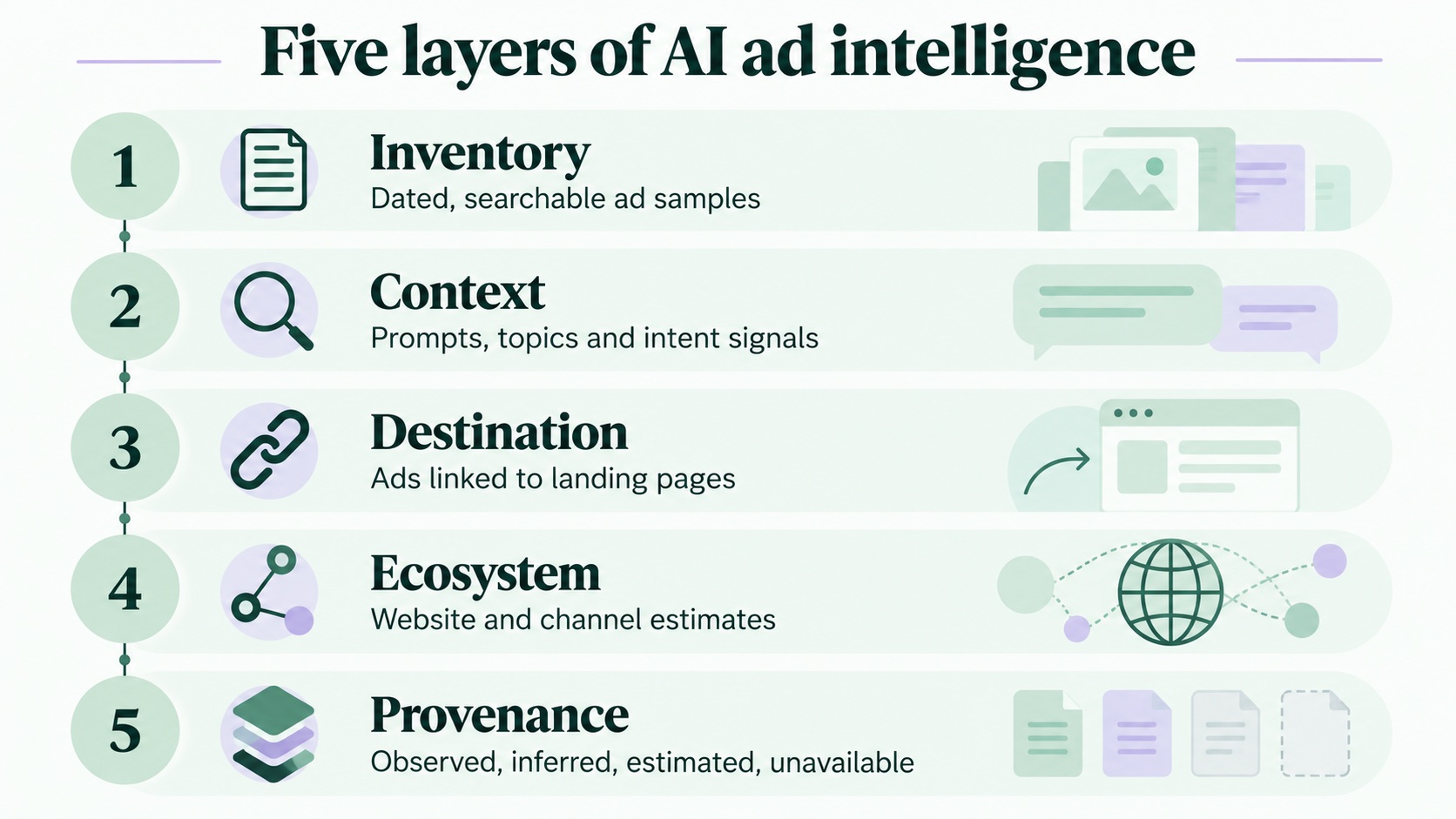
Figure 1 — Five layers, from inventory to provenance. The layers connect source inventory with the provenance needed to interpret it.
Layer 1: Inventory — A Dated, Searchable Record
The foundation is a structured, searchable set of observed advertising samples with a visible snapshot date. That means you can filter by advertiser, domain, industry, creative text or date range — not type into a search box and hope.
Two details in this layer separate serious platforms from casual ones. The first is date provenance: every record should carry a last-observed date and, where the source supports it, a date range. An undated record quietly turns into a present-tense fact in a slide deck.
The second is the difference between a sample and a total. Any hand-collected or crawled inventory is a subset of what was actually served. A platform that says "45,000 observed ads" is describing its collection range, not the size of the market. That distinction has to appear in the product, not only in a footnote.
Layer 2: Context — What Was Happening Around the Ad
This is the layer that makes an AI ad observation different from a banner in a display database.
In a keyword-based advertising environment, the ad sits next to a query. In a conversational environment, the ad sits next to a problem someone was working through. If a platform records only the creative, you have lost the most valuable half of the observation.
What we look for here is a record of the associated conversational context — typically presented as prompts, topics and intent signals — along with an honest label about where that context came from. Intent tags like Research, Compare, Buy or Solve a problem are useful organizing devices, and they are inferences, not measurements. Labels generated by a classification model should say so.
The reference point we hold vendors to is simple: a mature research product is willing to return Unknown when the source evidence is thin. A platform that classifies everything is not more capable; it is less careful.
Layer 3: Destination — Closing the Record
Most competitive ad research stops at the creative, which is where it loses most of its value. The creative is a promise; the landing page is what the advertiser believes will convert.
An intelligence platform should link a record to its target URL so you can read the ad and the page as one unit, and spot the gaps between them — an offer in the creative that the page buries, a product line the ad leads with that the page does not mention.
This layer is also where the funnel becomes traceable. Without it, you have a collection of pretty pictures and no conversion path.
Layer 4: Ecosystem — Placing Ads Inside Channel Reality
Advertising observations get more useful when you can put them against the broader acquisition picture. That means website-level signals: estimated traffic trends, channel structure, generative AI referral share and source platforms, and for some markets search visibility, paid search competitors and backlink profiles.
We use this layer for one purpose: establishing a channel baseline so that an advertising observation has somewhere to land. It is context, and we treat every figure in it as a third-party estimate.
The failure mode here is subtler than it looks. It is tempting to read a rising AI referral share and conclude that paid AI advertising is working. That conclusion is not available from this data. AI referral traffic has many causes, and attribution to a specific paid placement requires first-party evidence that no external research tool can supply.
Layer 5: Provenance — Labelling What You Cannot Prove
The highest layer is the one most often missing, and in practice it is the one that decides whether a report survives scrutiny.
A trustworthy platform separates four kinds of information:
- Observed values — what the source record directly shows, such as creative copy, advertiser, domain and URL.
- Inferred values — model-assigned industry, topic and intent tags, where confidence scores are not measured accuracy rates.
- Estimated values — third-party modelling of traffic, referrals, CPC and traffic value.
- Unavailable values — audience demographics, private targeting, complete historical AI traffic totals, first-party conversions and actual ROI.
When a platform keeps those four apart and shows its snapshot dates, you can build a report that holds up in front of a client. When it merges them into one confident-looking dashboard, every number in your report becomes an assumption you cannot defend.
Four Ways to Build the Same Three Layers — and Why They Are Not Equivalent
Inventory, context and destination can be assembled four different ways. Teams frequently compare the outputs without accounting for the differences in method.
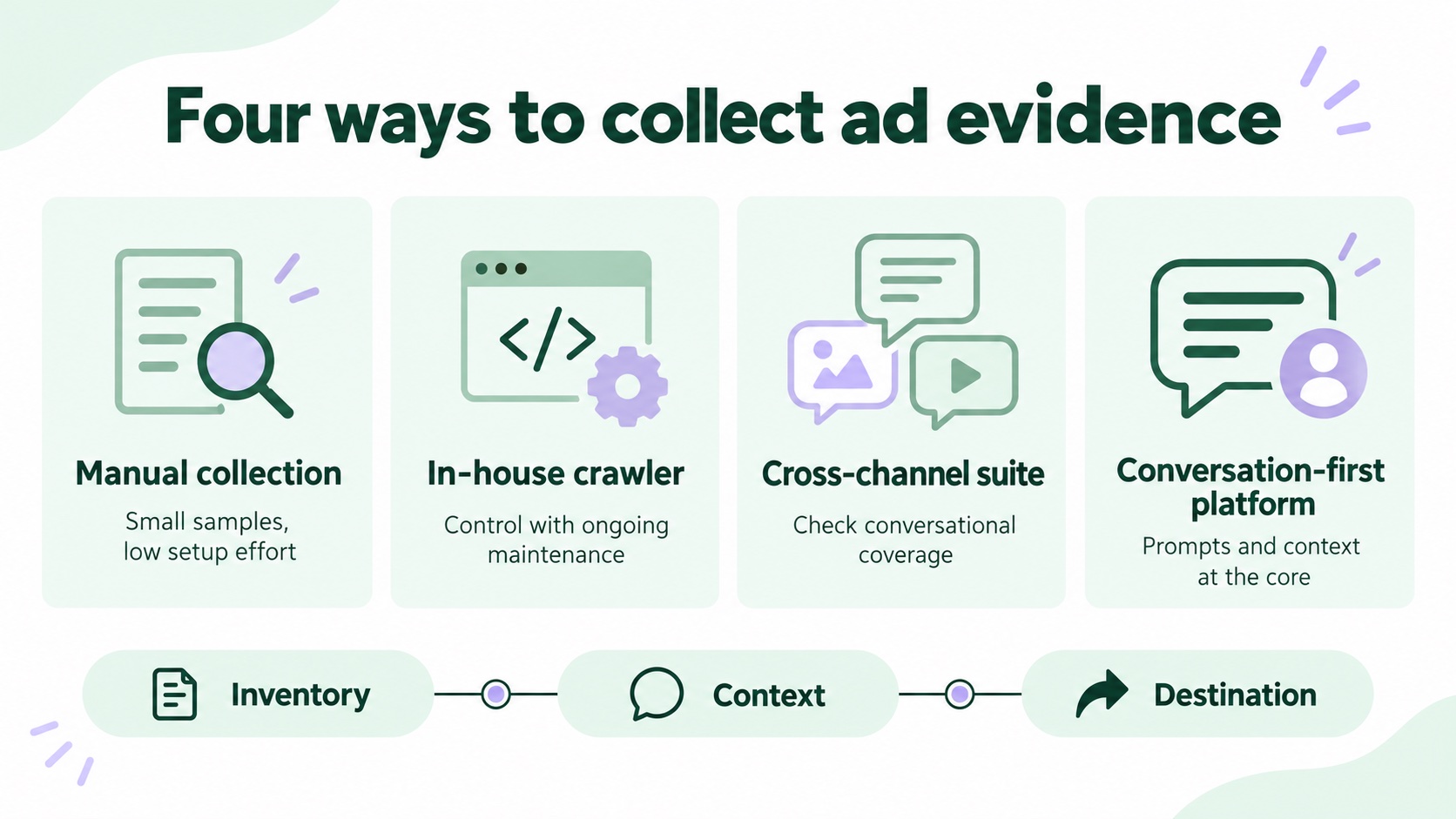
Figure 2 — The same three layers, four build methods. The right choice depends on how narrow your question is and how much maintenance you want to own.
Manual collection. Screenshot what you see, log it in a spreadsheet, repeat. Direct software costs can be low, though collection takes time. The ceiling is that the sample is limited to what you personally encounter, and coverage varies with what each team member encounters.
A crawler built in-house. Full control, and you own the collection logic, the labelling and the continuity. The cost is permanent engineering attention, and the method is hard to hand to someone else.
A cross-channel ad intelligence suite. A mature vendor with a large existing search and social dataset adds a conversational channel. The workflow is familiar and the category coverage is broad. The question to ask is how deep the conversational layer goes and whether it is labelled as observed or as inferred.
A conversational-native platform. A product built in this environment from the start, with associated prompts and conversational context treated as first-class fields rather than a new tab added to an existing product.
We are deliberately not ranking these. A small team with a narrow question and a two-week timeline may be better served by the first option than by any subscription. The mistake is not choosing manual collection; it is choosing manual collection while believing you have built a measurement system.
Reading the Data Before You Choose
There is one more question that separates platforms: what does a record look like underneath?
We want a source record trail — a way to see where a given observation came from and when it was collected — because it is the difference between a finding we can re-check later and a screenshot we have to trust. And we want field-level honesty about gaps. Missing data that resolves to a visible Unknown is a feature. Missing data that quietly resolves to a zero is a bug that will eventually reach a client deck.
How ChatAdsWatch Maps to the Five Layers
ChatAdsWatch is an independent ChatGPT advertising research platform built for growth, advertising, product marketing, SEO/GEO and competitive intelligence teams. It is a third-party research product, not an official OpenAI advertising dashboard, and it should not be used to manage or report on your own ad account.
Against the framework above, here is where it sits.
Layer 1 — Inventory. The ad library is organized into four views: Ads, Advertisers, Buyer Prompts and Landing Pages. Records can be filtered by advertiser, domain, industry, topic, intent, source niche and date range. Records show a last-observed date and, where the source supports it, a first or last collection time; unavailable dates remain unknown. The published figures describe the collection range of the current snapshot, not the total volume of ChatGPT advertising.
Layer 2 — Context. Individual records can be viewed alongside the associated prompts captured with them, with topic and intent tags visible across Research, Compare, Buy, Solve a problem and Unknown. Some of these tags are model-inferred, and confidence scores are not measured accuracy rates. Prompts are conversation signals, not search volume, and they are not stable advertising triggers.
Layer 3 — Destination. The Landing Pages view connects target URLs back to related ads and records, so a product line, a value proposition and a conversion page can be read as one chain.
Layer 4 — Ecosystem. A Website Analysis module covers estimated traffic trends, acquisition channels, AI referral visits and source platforms, visitor quality metrics and geographic distribution where data is available. An optional Search intelligence layer adds search visibility and competitor data for selected markets. These are third-party estimates, and the AI referral figure cannot be attributed to paid ChatGPT advertising on its own.
Layer 5 — Provenance. As described in our methodology, the product distinguishes source-record observations, model inference, third-party estimates and unavailable fields, and shows snapshot dates. Captured appearances are records of an ad appearing in the collected sample; they are not impressions, clicks, spend, reach, conversions or advertising results.
That last sentence is the most important one in this section, and we would want to see an equivalent statement in any platform we evaluated. A vendor that will not name the limits of its own data is telling you something about the rest of its claims.
The Evaluation Checklist We Use
When evaluating an AI advertising intelligence platform, these are the ten checks to run, in order. Most failures happen quietly, which is why each one includes the silent failure it prevents.
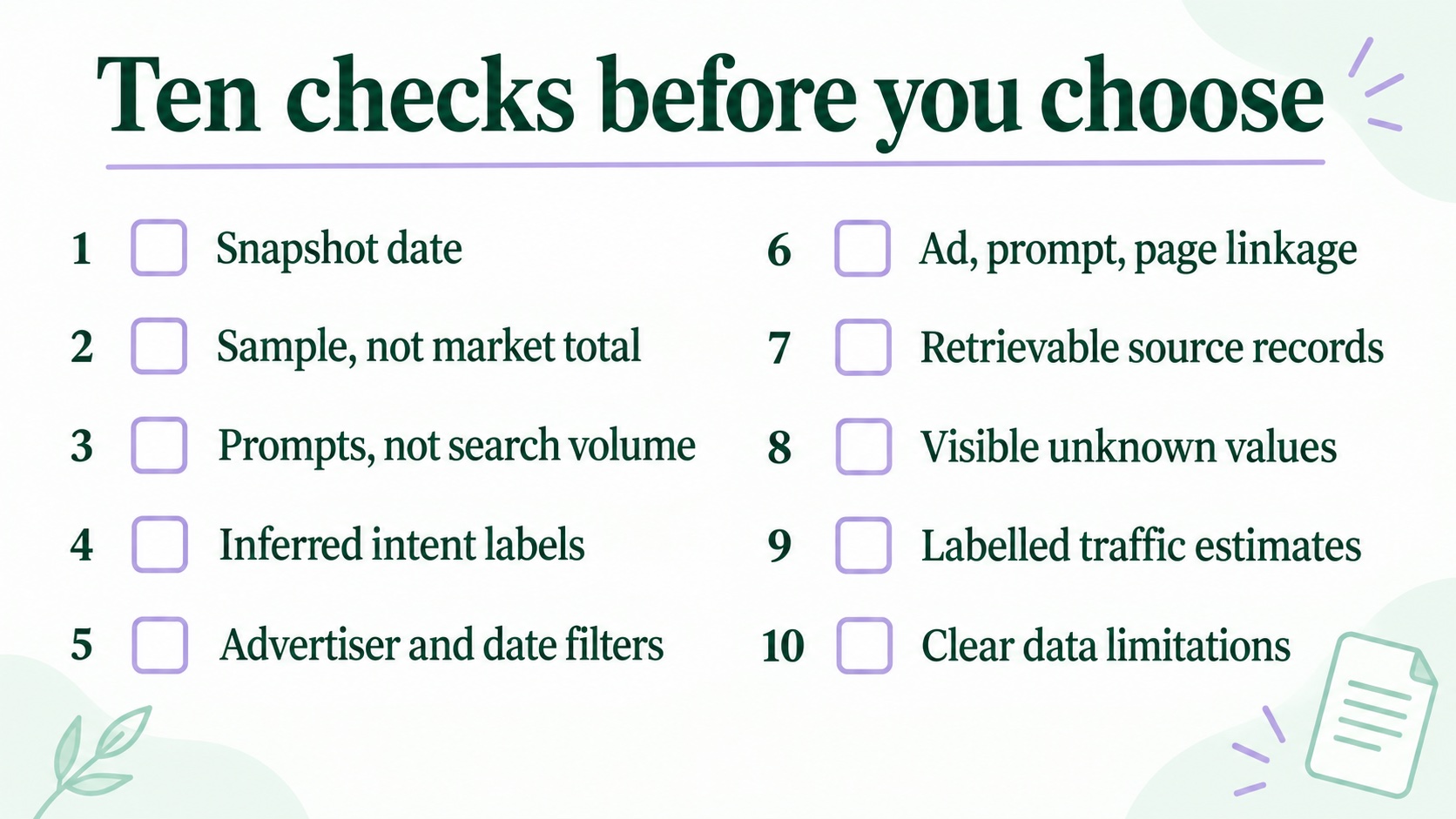
Figure 3 — Ten checks and the failure each one prevents. The first four help identify common evidence gaps.
- Does the sample carry a snapshot date? Undated figures get read as current.
- Is the sample presented as a subset? Record counts get quoted as market size.
- Are prompts labelled as context rather than volume? Conversational signals get treated as search demand.
- Are intent and topic tags marked as inferred? Model guesses get reported as user behaviour.
- Can you filter by advertiser, industry and date? Research stops at free-text search.
- Does one record link ad, prompt and landing page? The chain breaks and each view becomes an island.
- Is a source record retrievable per record? Findings cannot be re-checked or defended.
- Does missing data resolve to a visible Unknown? Confidence is manufactured rather than measured.
- Are website and AI referral figures marked as estimates? Third-party models become first-party facts.
- Does the platform state what it cannot support? Spend, ROI and targeting get inferred anyway.
A platform that passes one through nine and fails ten is still risky, because the absence of a stated boundary is what allows a research team to over-claim later. We would rather use a narrower platform with clear limits than a broad one that never says no.
What Any AI Advertising Intelligence Platform Cannot Prove
This section is worth reading before using the data in a deliverable.
Captured appearances are not performance. A recorded observation means an ad was seen in the collected sample. It is not an impression, click, spend figure, reach number, conversion or revenue result. Any efficiency metric built on appearance counts is measuring collection activity, not advertising outcomes.
Prompts are not search volume. They describe conversational context around a sampled ad. They are not query counts, and they are not confirmed targeting rules.
Website and referral metrics are third-party estimates. Traffic, AI referrals, CPC and traffic value come from third-party modelling. They do not replace Google Analytics, Search Console, advertising platform data, CRM records or internal attribution.
AI referral traffic is not automatically paid advertising traffic. Any attribution claim requires first-party evidence.
Inferred labels are classifications, not facts. Industry, topic and intent tags may be assigned by a model, and a confidence score is not a measured accuracy rate. Where the source evidence is insufficient, the correct value remains Unknown.
Coverage is dated and partial. An ad library is a historical snapshot. It does not represent every advertisement that was ever served, and it should never be described as such.
Some things stay unavailable. Audience age, gender, private targeting, complete historical AI traffic totals, first-party conversions and actual ROI cannot be inferred from published research pages, and a platform that offers them is estimating, not observing.
The practical rule we follow: use a platform like this for market evidence and testable hypotheses, and use first-party systems for campaign measurement. The two answer different questions. Keeping them separate is what makes both trustworthy.
Which Layer Should You Start With
If you are deciding where to begin, start with your decision rather than the largest dataset.
If your question is what is this competitor saying, you need Layer 1 and Layer 2, and you can start this week. If your question is where do the ad and landing page diverge, you need Layer 3. If your question is how should we rebalance channels, you need Layer 4 and a much clearer definition of what you already know from your own analytics. And before any of it enters a client-facing document, you need Layer 5.
A practical combination is a platform with relevant catalogue coverage for Layers 1 through 3, your own analytics for Layer 4, and a written set of data boundaries for Layer 5. That combination is not glamorous, but it produces research that survives questions.
Frequently Asked Questions
Is an AI advertising intelligence platform the same as an ad management tool?
No. Ad management tools optimise campaigns you are running, using your own account data. An AI advertising intelligence platform observes advertising you do not own — competitor activity, market samples and channel context — so it can inform decisions before any spend happens. The two categories have different data sources, different success metrics and usually different vendors.
Can these platforms tell me the ROI of ChatGPT advertising?
No. Advertising ROI requires actual spend and attributed conversion or revenue data tied to a specific advertiser's account. A third-party research platform records observed samples of advertising appearing in AI conversations, which is a different thing entirely. ROI measurement belongs with advertising platform reporting and first-party analytics.
What is the single most useful field when evaluating one of these platforms?
The snapshot date, followed by the source record. A dated observation can be placed in a timeline and re-checked later; an undated one cannot. If a platform cannot tell you when a record was observed and where it came from, the rest of its feature set will not rescue the research that gets built on top of it.
Sources and Editorial Note
Published by ChatAdsWatch Editorial. The five-layer framework expresses our editorial criteria rather than an independent vendor ranking. Product descriptions were checked against our current implementation and public ad library and methodology on October 12, 2026. OpenAI's description of ads in ChatGPT explains contextual ad selection and the separation between sponsored ads and organic answers.
For a complementary selection guide, see How to Choose the Best Self-Serve AI Ad Research Platform.
Put the checklist to work
Start with a real advertiser.
Browse the public library, inspect the methodology, and decide whether the collection fits your market.
Explore the ad library →All articles